Saturday, August 23, 2014

Muay Thai, Jun Fan JKD & Krav Maga: Northshore Academy of Martial Arts: Libertyville, IL

Background: I found myself at Northshore Academy of Martial Arts (NSA) courtesy of a friend of mine, Randy Siordia. Randy and I got connected through social media, and he invited me to come see what NSA did. When I pulled into the parking lot I saw what looked to be a small school sandwiched in a strip mall. Having trained in plenty of small schools, apartments and parks this wasn't a problem for me. However, when I opened the door, I realised that the school stretched much further back and this was anything other than a small school.

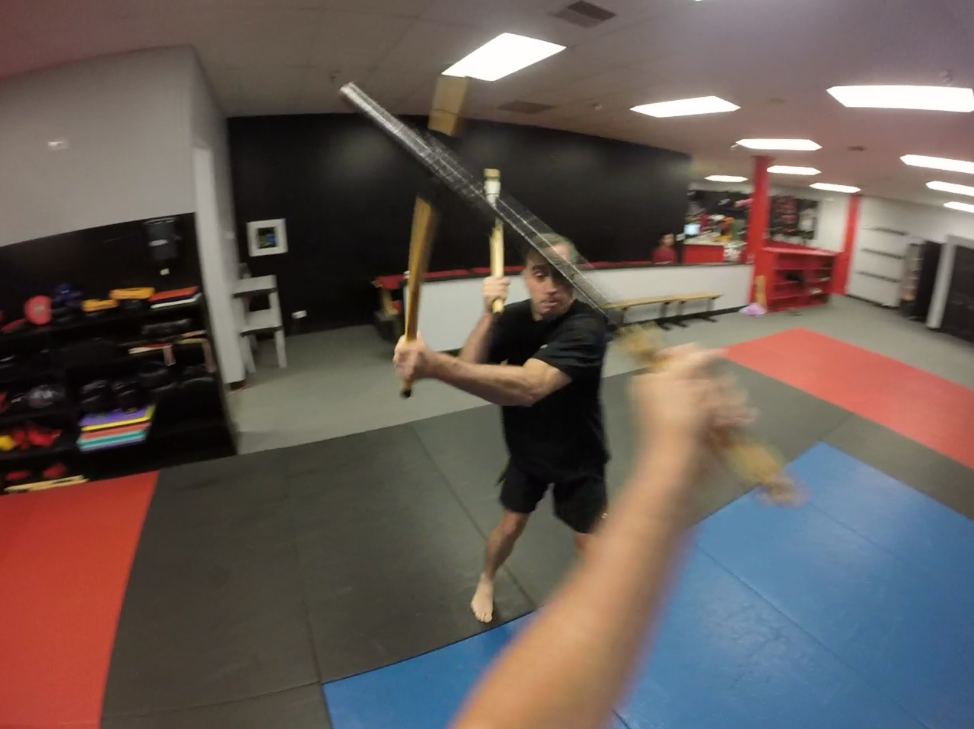
Physics at work. You can see our sticks bending on impact.

Northshore Academy is a modern training facility and is equipped to handle a variety of Martial Arts programs. Since I adore Martial Arts I decided to participate in the three programs being offered that evening. It was going to be an evening of Muay Thai, Jun Fan Jeet Kune Do and Krav Maga which meant I was going to get pushed to my limit.

What makes Northshore Academy a great place to train is that Head Instructor Marc Halleck has acquired a fantastic staff to back him up. Each class is taught by a well trained, experienced instructor with the other instructors participating in the class to prevent "instructor fatigue." Instructor fatigue isn't often considered but having travelled around the continent I can tell you greatly effects a class. When instructors get tired they stop engaging their class, the pace slows down and the class is generally disorganized. Whether or not you are even cognisant of it when you get tired and sloppy as a teacher your class sees it and soon they go somewhere else.
Practising groin kicks is a blast with these bags. Unload at full force. 

The way Northshore Academy is structured prevents this. Whether it was intentional or not, it provides a great environment that is full of energy to learn from. 


What did I learn: Between the three classes I learned a ton of new tips to bring up my techniques. Certainly the class that I learned “most” from was the Jeet Kune Do/ Jun Fan stick fighting. We hopped straight into double sticks and I had to get my coordination down. I have always favoured certain sides when fighting or sparring. While fighting with my hands I almost always fight left leg in front switching when I did Historical European Martial Arts I brought right leg forward. Suddenly, I had to contend with ambidextrous drills and was pushed to get my body into alignment to intercept strikes using either leg.
I am reminded that in a real fight my hand would be gone. 

As a fighter it is great to get pushed outside your comfort zone. Having to switch sides and compensate for that discomfort is something that every fighter should go through. When I was competing I can tell you that I was constantly trying to stay in my comfort zone while pushing my opponent from his. Largely, I was very successful. However, despite this there were times that I was pushed well outside where I wanted. Being able to adapt is critical in these situations and I really felt doing the Jun Fan helps develop those skills.

What was awesome: I really enjoyed the approach to the Muay Thai and Krav Maga. During the Muay Thai class we worked on range drills. As a tall guy I love fighting at a distance and making use of my long limbs, however, this in itself wasn't special. What made the drill amazing was the instructor teaching it was a 'swarm fighter" meaning he likes to get in close and overwhelm opponents with close range techniques. Regardless, he realised that every fighter is different and needs to develop their own skills. 
Working in a round kick as part of a multi-strike combo.

I have met many instructors that don't teach to the student and rather teach to themselves. They understand what made them good and that is all they teach. The problem with teaching this way is that it confines you to an incredibly small set of experiences. Even teachers that have fought in competitions, former police officers, soldiers, etc.. have only seen a tiny number of scenarios when weighed against the collective experience of the many. Any successful fighting program, whether competitive or reality-based, leverages multiple coaches and experiences. George St. Pierre, one of the best ever MMA fighters, has trained with Olympic wrestlers, fight teams in Montreal, New Mexico and Brazil, etc... to broaden his experiences. Krav Maga & Jeet Kune Do both have been excellent about grabbing as many resources as they can. It was great to see the NSA embraced this and keeps growing instead of being locked in its own self-aggrandizing static glory. 
Working in long hooks to stay out at range instead of swarming in.

The other thing I really liked was the way the Krav Maga was handled. Guro Marc Halleck drilled us not only on technique but on the legal ramifications of our actions. All to often I will see instructors teaching that they need to "end the fight" without thinking about how the fight must be ended or the consequences. Marc Halleck coached us to always keep thinking as the situation progressed. Reminding fighters to constantly re-evaluate the situation and keep their use of force to within acceptable limits is very important. Sometimes I will see people get caught up in the fantasy of a Martial Art and forget that the world is an extremely diverse place. The acceptable techniques are extremely different if you are an Israeli soldier in the West Bank or a civilian at a party in Chicago. It was great to see an instructor emphasize this. 
Working on some basic pummelling and defence drills.

Conclusion: Northshore Academy of Martial Arts is a great place to train. From their reliance on multiple instructors to keep the classes fresh to their breakdown of sportive and self-defence programs I had a great time. It was great to see an academy that acknowledges all the aspects of Martial Arts. 
Great academy. Go check them out. 

Best regards and keep training,

Martin "Travelling Ronin" Fransham 

If you are interested in training together I would love to get together with you. Drop me a line on facebook and we can connect. I would love to learn from you. On Facebook: https://www.facebook.com/pages/Travelling-Ronin/583588935029877?ref=hl
On Youtube: http://www.youtube.com/playlist?list=PLwXDjTjOSVMm3-98e0gHUXLlQecYRkcvN

Go see NSA's website and more of what they do: http://nsama.com/
Randy Siordia of Wolf Martial Art's directed me over to NSA. Go look at his stuff as well. http://www.wolfmartialarts.net/


Tuesday, August 5, 2014

Haidong Gumdo: Friendly Practice Group: Ottawa, ON

Background: Haidong Gumdo* is a Korean sword art that is growing in popularity in North America. It revolves around the use of the Ssangsoodo, a two-handed sword that is similar to the Japanese Katana. The Hai Dong Gumbo association arose in April of 1983 in Seocho-gu, Seoul and in 1996 was incorporated as the World Hai Dong Gumdo Federation. Since that point it has slowly spread across the globe.

I was introduced to Haidong Gumdo by a friend of mine Chris Ouillet. He and his wife had been training for years and rented space at a local karate dojo to train themselves. Over time they have gathered a group of dedicated sword practitioners interested in learning top-notch skills. Naturally, I was curious to find out more about this art.
Chris yells at me to lower my stance and work my legs.

Unlike so many other of the Asian Martial Arts where they just practice their forms and slash at the air, Haidong Gumdo believes in being a fighting art. Similar to any art that carries a combat focus they are all about eliminating excess and techniques that are simply there for flowery effect. Of course there is a "pageantry" or "show" side of Haidong Gumdo that is used in demonstration, however, this is present in all Martial Arts. At its core Haidong Gumdo is a functional art.

In Eastern Canada the Haidong Gumdo tournament seen is very limited. Therefore, Haidong Gumdo fighters tend to drift across several arts from Kendo to Historical European Martial Arts. Where you find a culture that swung long swords you will find fighters of this Korean sword art. Rather than being purists the cross pollination across several arts makes them strong fighters in numerous types of combat.
Chris and I competing at the Borealis Sword Symposium in 2013.

I joined Chris at the 2013 Borealis Sword Symposium and had the privilege of fighting beside him. Before entering the longsword division Chris gave me a number of tips that kept me more or less alive and allowed me to win my fights. Borealis was a tournament for Historical European Martial Arts but attracted the Haidong Gumdo fighters. You can also find them at other tournaments like Longpoint in Boston and other tournaments beyond practising and perfecting their craft.
The Ssangsoodo is the sword in the center and is flanked by Katanas. 

What did I learn: Obviously, I come from a background of fighting with my hands so fighting with weapons is largely new. I have taken three months of Historical European Martial Arts with a great group in Montreal called Arte Dimicatoria and they taught me a lot but I am still the most basic of beginners with the bladed arts. Spending a couple of hours working on my fundamentals is invaluable to me. From basic stances to beginner cuts, spending time working these techniques ups my survival rate.
Footwork and speed are crucially important as I lag behind. 

Unlike the striking and grappling arts, bladed arts are terribly unforgiving to mistakes. You can roll with a punch or fight through a submission attempt but you cannot fight through a sword cut. Massive trauma begins to shut the body down and limits someone abilities to fight back. With a focus on moving fast, getting in and getting out, Haidong Gumdo does its best to keep it's fighters alive and safe.
I get pressured to keep my range during a spacing drill. 

What was Similar: Immediately, I was impressed by the work ethic of this group. Although they say that they're a casual group just training for themselves they carry themselves like anything otherwise. They have a dedicated training plan that they follow that brings them through cardio, strength training and basic techniques. With the conclusion of their fundamentals they suit up and begin sparring and other combat techniques.

Solid foundations are worth more than all the advanced techniques in the world. If you don't have sound footings for your fighting style it crumbles under pressure. I have spent countless hours throwing jabs to perfect my striking. Haidong Gumdo is no different, hence all those basic cuts that we warmed up with. It was great to see that even in this small group didn't shrink the easy to forget basics.
I challenged Chris to a ridiculous fight with foam staffs since I lacked protective gear.
I was cut to pieces. 

Conclusion: Sometimes who you train with is what you defines you as a Martial Artist. It doesn't require the biggest gym or a thousand people that are just interest in showing up. You need dedicated people who strive to better themselves each and every time they train.
An evening training with great people. 

Best regards and keep training,

Martin "Travelling Ronin" Fransham

If you are interested in training together I would love to get together with you. Drop me a line on Facebook and we can connect. I would love to learn from you. 

*I found "Haidong Gumdo" spelt in numerous fashions, Hai Dong Gumdo, Haedong Gumdo, etc... I chose to use the spelling Haidong Gumdo unless an association or group spelt it differently. 

If you are in Ottawa and want to train with a great Haidong Gumdo group Give Chris an email: rabbit.of.war@gmail.com

Sunday, July 13, 2014

Muay Thai: Grizzly Gym: Kingston, ON

Background: Muay Thai exploded into western consciousness with the rise of UFC and Mixed Martial Arts in general. What had been viewed in the past as an eclectic Martial Art suddenly blew up as one of the most functional and dangerous fighting styles in the world. As fighters learned to overcome the grapplers and wrestlers in MMA it gave rise to infamous "Sprawl & Brawl" fighters before gradually growing into more complete fighters.
Kru Pete checking a kick beautifully.

What is it that makes Muay Thai so dangerous in the ring over some of the other fighting styles like Kung Fu and Karate? Is it that Muay Thai is fundamentally better than other Martial Arts? As a fighter with a background in Chinese Martial Arts I have always been curious on this. Surely no fighting style is better than another? Yet, if that statement holds true, why does Muay Thai produce so many champion fighters?

I reached out and contacted an old friend of mine, Mike Martelle, in order to get a better understanding. Mike and I competed against each other and have trained together on numerous occasions. Mike now runs his own gym in Kingston, Ontario and has led the Grizzlies into battle all over North American and beyond. Mike himself has fought around the globe, competing from Russia to Central America making him ideal to ask about the strengths of Muay Thai.
Kru Cody whipping a kick out at his adversary. 

Mike was more than willing to oblige me and, even better, he let me bring a couple of friends of mine. This let us host a whole gathering of Travelling Ronins. Kru Cody and Kru Pete were teaching the Muay Thai class and provided a wicked experience where we worked through some basics and then drove us into some more advanced techniques. It was a great day of Chinese Sanda fighters learning from Muay Thai fighters and a mixing of techniques.
Mike Martelle (left) and Eugene Shewchuk (Right) have both
played a great roll in developing me as a fighter.

Now, Mike was extremely gracious and let me film everything. However, all but the group photo are taken from the Grizzly Gym facebook page. Unfortunately, my camera was lost in a completely preventable fishing accident and the footage I shot was lost as well.

What did I Learn: I am extremely comfortable in fight gyms having trained in so many over the years. So I always like it when a fight gym can take things to the next level and really push me. After warming up with some standard callisthenic exercises we dove straight into working on a series of wicked combo drills. With the rotations it forced us to work with a variety of partners and body types to get our technique down.
Kru Cody (left) ran us through some awesome drills.

I also loved that the Grizzlies work into some incredibly tough and complex combos. I have seen a lot of schools that stop at four strike combos. Kru Cody had us blasting way beyond that in order to help develop the "killer instinct" necessary to win fights. "Killer Instinct" isn't about being violent or brutal, it is about continuing to press the assault when you have momentum. Far too often fighters will throw a couple of punches and than stop to assess the damage they have done allowing their opponent to gain their breath and reset.

What was similar: With my background in Chinese Sanda and MMA there were a lot of techniques that were familiar to me. With a few technical differences on how you throw a kick or a punch Muay Thai was easy to slip into. The Grizzlies were preparing for a fight that was coming in two weeks and you could see the competitive spirit radiating from them.
Grizzly Gym fighter PJ Ste Marie after his May 3rd, 2014 MMA Victory.

Fighters carry themselves with an easy confidence and it is wonderful to be around. Neither Kru Cody or Kru Pete had any ego in working with the fighters I brought down and so we were free to exchange techniques and learn. It was fantastic that Coach Mike Martelle had imposed such a great atmosphere to come train in. All my crew left asking when they could meet with the Grizzlies again.

Conclusion: Friendships like the one I have with Coach Mike Martelle are what make Martial Arts so much fun. I had a question on Muay Thai and he brought me in without hesitation. It is the mark of a true Martial Artist. 

To answer why Muay Thai fighters are so dangerous the answer was clear. Preparation and structure allow the style to turn out fantastic Martial Artists. I often saw Kru Cody refer to a lesson plan throughout the day which implies goals for the lesson and a focus on fighter development. It also means he wasn't just "winging it," rather approaching the training in a results orientated strategy. Muay Thai makes great fighters because they have a goal, measurable objectives to achieve it and structured approach to their training. I certainly will take that lesson with me.
A great day training with some old and new friends!

Best regards and keep training,

Martin "Travelling Ronin" Fransham 
If you are interested in training together I would love to get together with you. Drop me a line on facebook and we can connect. I would love to learn from you. 

On Youtube: Travelling Ronin

Go take a look at Grizzly Gym: http://www.grizzlygym.com/

Sunday, July 6, 2014

Pekiti-Tirsia Kali: RFA Martial Academy: Addison, IL

Background: I have loved fighting with weapons for as long as I can remember. However, most of my introduction to weapons had come in the form of Medieval Martial Arts and Chinese Martial Arts. I had almost no experience with Filipino Martial Arts. Sure I had heard of Kali but other that knowing they did “stick fighting” I couldn’t have told you much about it.
Paul Ingram charging forward to slash me to ribbons.

Kali has many other names and you will sometimes hear of it referred to as Arnis or Escrima due to the Spanish influence in the Philippines. Like all of the Martial Arts I visit I was surprised by how rich and diverse the culture of fighting goes in Kali. This was anything but mere “stick fighting.” Filipino Martial Arts are as different and incredible as any of the Chinese Martial Arts I have studied. 

What I have always found extremely interesting is how cultures adopt from each other. During the colonial era Spain influenced the Philippines enormously. The sea-faring nations exported their cultures around the globe bringing various ideologies and technologies with them. Today, the situation is reversed. Kali is being exported around the world and has become a part of the Martial Arts of several militaries.
We started warming up with a basic pattern to develop timing. 

Pekiti-Tirsia Kali is one of main systems of Kali and was officially created by the Tortal Family in 1897. The current head of the system is Grand Tuhon Leo Gage Jr. who has been extremely devoted to growing this system of Kali. Beneath him gentlemen like Tuhon Tim Waid have been teaching the Filipino Marines and giving seminars around the world.

Paul Ingram was one of the people that got hooked on Tim Waid’s teachings and has dedicated himself to PTK. Paul is quite short and sought to level the field between him and larger fighters. When confronted with kickboxing or grappling he found they favoured a larger fighter. Indeed, the UFC will never place Demetrious Johnson against Jon Jones. Weapons provided that equalizer he was looking for. Suddenly speed killed and every strike was devastating. PTK turned a smaller fighter into a human weapon.

Tom takes my wrist. 

What I Learned: Pekiti-Tirsia Kali is described as a system not an art which I found very interesting. Paul stressed several times throughout the evening that a system is what you use and an art is what you create. The example that stuck with me the most was that of a painter. A painter / artist will use a system to create the piece they are working on. A baroque painter and a modern painter will both create “art” based on how they approach the canvas yet the result will be radically different.

The same is true with Pekiti-Tirsia Kali. Students are encouraged to learn the system and then create their own expression of the art. Larger fighters, like myself, might hit harder and stronger whereas a smaller fighter becomes fluid and flows faster.  It was this incredible dynamic of structure mixed with self-expression that I really enjoyed from RFA Martial Academy.
Paul and Tom working at full speed. 

The name stands for “Require Further Achievement” and is designed to push you and to not except limits. The limitations we face are largely self-imposed and RFA Martial Academy asks you to always continue learning and growing. There is no end just simply a new challenge to look at and conquer. Paul Ingram lives the philosophy that you should never stop growing and improving.

What was Similar: RFA Martial Academy matches some of the top schools I have been to because of their openness to questions. Paul is a believer that you should challenge and push your teacher. The strength of any system, whether it is Kali or another Martial Art, is its ability to withstand questioning. If your style and primarily your teacher cannot accept being pushed to answer hard questions then perhaps there is a fundamental flaw in what you are learning.
Tom slashes my face. He stopped with perfect precision. 

Teachers need to be open and welcoming with their students’ questions. It is something that my first teacher, Sifu John Hum, strove to install in me. When I took up grappling, Coach Eugene Shewchuk, was always there and answering questions. As an instructor your students should be helping you grow and making you a better teacher. 

Conclusion: A big reason I try to train with new groups and new people all the time is because it helps pull back the veil of ignorance and helps me grow as a Martial Artist. RFA Martial Academy showed me that Kali is way more advanced then I had ever imagined. I can't wait to see more of it. 
Awesome night training with a fantastic crew of people at RFA Martial Academy. 

Best regards and keep training,

Martin "Travelling Ronin" Fransham

If you are interested in training together I would love to get together with you. Drop me a line on facebook and we can connect. I would love to learn from you. 

Check out RFA Martial Academy: http://www.rfamartialacademy.com/

Sunday, June 1, 2014

Jeet Kune Do: Ballistic Fighting Methods: Bartlett, IL

Background: I first visited Sifu Nik Farooqi in 2013 while travelling through Chicago. It was an awesome experience and got me excited to try more Jeet Kune Do. This translated into a trip to Focus JKD in Nashville where I got a much better idea of what Jeet Kune Do is. The aggressiveness and drive that I saw in both Focus and Ballistic really hooked me into exploring this art more.

When I moved to Chicago I looked up Sifu Nik in order to continue to explore Jeet Kune Do. I really wanted to get a better understanding of how Jeet Kune Do fit within the modern world. Bruce Lee was one of the greatest Martial Arts promoters of the 20th century. Whole generations of Martial Artists have been inspired by what Bruce Lee did.
Jeet Kune Do bursting carries fighters in and out of combat.

Actually, the father of mixed martial arts, if you will, was Bruce Lee. If you look at the way Bruce Lee trained, the way he fought, and many of the things he wrote, he said the perfect style was no style. You take a little something from everything. You take the good things from every different discipline, use what works, and you throw the rest away.” – Dana White, President of the UFC.

Bruce Lee might be a controversial figure within the world of Martial Arts and there are certainly some that will debate his legacy. However, regardless of what you think about Bruce Lee there is one thing that all Martial Artists can agree on, Bruce Lee has been dead a long time. In the thirty-one years since his death the style he created could have either have grown and flourished or diminished into nothing.
Tossing my partner over me. He recovered instantly with Ballistics ground game. 

It was great to see that Ballistic Martial Arts is certainly the former case. They have taken the philosophies laid down by Bruce Lee and the following generations to grow even further. Ground fighting and submission wrestling are now part of the Ballistic arsenal. Sifu Nik is also certified firearms instructor and teaches a variety of weapons self-defence classes and programs. Although this may seem counter to Bruce Lee’s lightning fast hands it should be noted that Bruce himself was known to carry a .38 revolver and a 1911 automatic. The weapons are simply an extension of the JKD program.

What did I learn: Ballistic Fighting Methods actually conducts their class “backwards” against many contemporary programs. Most classes will do some kind of warm up, basic drills and then move into sparring. Ballistic flips this paradigm on its head by having you jump straight into sparring and grappling. I really enjoyed fighting this way because you enter the fight fresh. Well sometimes…
I drive my opponent back with a kick.

Ballistic Fighting Methods also runs a wicked cardio program. Combining kettlebells with some cardio and strength exercises pushes you to your max. Sweet drenched with muscles burning you get dumped into sparring. Personally I found this to be an excellent way to attack your training. This has you entering your fighting anywhere from perfect fighting shape to bone tired depending on the night. This diversity in the range of how you engage a fighter is excellent for developing a tactical mindset.

Defaulting to my experience of competing in a variety of tournaments I truly see the value in a drill like this. It would be a wonderful world if I always got to engage opponents that I was fresher, stronger and faster than them. Reality is painfully different. I have been in fights where I was fresher than my opponents and others where I was wondering how I was going to make it through the round. By fighting in this manner it forces you to consider a multitude of game plans and options to run through. You learn to be conservative while tired yet still engaging and how to bring the thunder when you are fresher.
Sifu Nik whips a kick into my mid-section. 

What was similar: Sifu Nik drilled us hard on the concept of switching levels and switching angles. We worked on “selling techniques.”  I love to “sell” techniques to people and use my background in Praying Mantis to do it a lot and I am constantly changing levels. In my last visit to my friend Sifu Tom Lugo’s Integrated Kung Fu Academy we worked heavily on fakes and how to bait your adversary in. These techniques mirror across many arts.
Bruce Lee's backfist was infamous and Sifu Nik has adapted it to work in the modern world. 

The reason that changing levels and selling fakes is such a big part of my game is simple. I am a big guy and as a big guy I telegraph many of my techniques. It’s a factor of size that I can’t control. If a small fighter twitches the movement can easily become lost in his motion. When I twitch that same motion covers a larger area and is more visible to my adversaries. Nothing I can do about it and shrinking anything other than my waistline isn't in the cards at the moment.

By “selling” someone a fake I can throw them off their game and bring them into mine. Although I focus on controlling my telegraphing I don’t make it a core focus to eliminate. Instead I use those very same tells against the other fighter. Because they can “see” my techniques I let them read the fake and think that they are going to intercept or block it. Once they commit to the fake I am able to slid into the opening and exploit it. Since this is an article on Jeet Kune Do it is fitting to cap this section with a quote from Bruce Lee. “To hell with circumstances; I create opportunities.
Sifu Nik showing me how to sell the technique. 


Conclusion: Ballistic Martial Arts was a great program. Covering stand up fighting to ground techniques, knives and sticks to firearms, Ballistic is constantly growing and evolving. Sifu Nik holds the “Warriors Weekends” where Martial Artists of all stripes get together to exchange techniques and grow. They aren't a static art lost in the past rather a dynamic art that remembers where it came from. 
A great class with great guys to learn from.

Best regards and keep training,

Martin "Travelling Ronin" Fransham

If you are interested in training together I would love to get together with you. Drop me a line on facebook and we can connect. I would love to learn from you. 

Check out Xtreme Training Academy: http://www.xtremetrainingacademy.com/

Sunday, May 18, 2014

Civil War: Battle of Atlanta: Keokuk, IA

Background: As a Canadian the American Civil War has fascinated me for years. It is a pivotal event in world history and marks the greatest loss of American life in war. Hundreds of thousands of young men sacrificed their lives in a conflict that pitted the North against the South. The implications were vast and far reaching effecting countries far beyond the United States. The Civil War provided much of the necessary backdrop for Canada’s Confederation and the drive to become a country.
Confederate cannons explode furiously on the field of war. 

Knowing that this event has played such a pivotal role in world history I jump on the opportunity to visit Civil War sites. I have had the chance to walk the battlefields of Gettysburg and Chickamauga, visiting the areas where armies crashed together. I can’t describe the eeriness of a battlefield and the ghosts that haunt the earth. Personally Chickamauga spooked me more than Gettysburg. I was familiar with the latter from the film of the same name and visited it on a bright, crisp fall day. I knew of Chickamauga through the work of Ambrose Bierce. He was a Civil War vet and wrote brilliant works about his experiences. I will put a link to his work below and highly recommend you read a couple when you have a moment. The description of the horror of the battle and the twilight streaked battlefield matched exactly what I saw.

When I heard that there was going to be a historical re-enactment happening close to the Quad Cities where I live, it was beyond doubt that I was going to attend. Keokuk, Iowa was a short two and a half hours away and completely worth the drive in order to see this new adventure.
A cannon in the foggy woods of Chickmauga still fending off ghosts.

What did I learn: I was blown away when I arrived at Rand Park. Battle Lines were drawn up and the armies were beginning to shuffle into position. I quickly decided that I was going to set myself a couple of quick goals. Despite there being an announcer I figured that his voice would quickly become lost over the roar of cannons. Since I wouldn't be able to hear the announcer I didn't know how the battle was to proceed. The only thing I knew was the final outcome. Therefore, I was profoundly curious about how terrain, noise and action effected my perception of the battle. What I saw versus what really happened might be two totally different things. Obviously, as a spectator I was not involved in the re-enactment, rather witnessed it from the sidelines.
Smoke obscures the battlefield blocking our vision. 

My suspicions about the announcer were confirmed the moment the first cannon fired. His voice was gone, lost to the roar of man-made thunder. I was standing slightly to the left of one of the cannons and a little in front. The shockwave from the blast rippled across myself and the spectators standing close. It was fantastic and I was laughing and smiling. Within seconds there was cheering and crying as small kids broke down under the noise. There was a full range of reactions in the second it took for the next gun to go off and blanket us once more in smoke.
Volley fire was amazingly terrifying to witness. 

I imagined trying to relay orders in the chaos and to make out what was going on. While I was pondering this the Union guns cut loose across the field. It was eerie to see the enemy line suddenly vanish behind a cloud of white smoke. A split second later the report echoed across to us which would have heralded a storm of death.

The Union cannon shroud their line in smoke.


Since we were embedded with the Confederates when they chose to advance we moved with them. We dropped down behind small rise and lost the right-hand side of the battlefield. The group we followed flanked a Union unit and proceeded to shoot them to pieces. I was so focused on the action in front of me that I completely missed the cannons being advanced till they announced their presence with a cacophony of sound.

Moreover, the Confederate unit I was shadowing succeeded in capturing the Union group and for all visual purposes “winning”. It wasn't till we change position that we saw a huge number of southern soldiers had been captured as well. I have read in a number of stories where one group would claim victory yet the vast majority of the army would lose. Ernest Yunger details it in his accounts of the first world war in “Storm of Steel.” Xenophon and the March of the 10 000 is another story where a highly successful group of Greek mercenaries win their portion of the battle while their employer is killed and the cause lost.
Confederate forces shelter behind a fence.

What was similar: The similarities called back to my time in the Royal Canadian Air Cadets. During my seven year tenure in the cadets I grew to be hugely familiar with the joys of marching and parading. Although the commands were different the units behaved much like the units of my youth. Unit Leaders badgered and cursed their soldiers into a line and got the dressing down proper. Once the troops were in line they marched forwards trying to hold that dressing as best as possible. Over the uneven ground it was nearly impossible yet they did a respectable job.
A plume of smoke heralds death.

I have also seen cannons fired in the past and was reasonably aware of the procedure that is required in order to shoot one off. However, there is something wholly different about seeing the a whole field of cannons roaring at each other. When I was in Halifax there was a whole ceremony that went with the discharge of the weapon. However, on the battlefield the orders where given and carried out in a fraction of the time. There was no ceremony, just simple and swift military precision executed flawlessly over a dozen cannon on both sides.


Conclusion: If you have the opportunity to ever check out a re-enactment of any sort you shouldn’t pass on the opportunity. History is buried in the past yet for a day you can unearth it and get a feel for how our ancestors lived. Nothing helps you appreciate the present like seeing the tools of the past. When you look at the tools of a battlefield surgeon and you compare that to the facilities that we have today it makes our current technology look nothing short of miraculous. Although we no longer fight in the manner of the Civil War you can still grow from the experience. 
A wonderful day filled with wonderful experiences.

Best regards and keep training,

Martin "Travelling Ronin" Fransham 

If you are interested in training together I would love to get together with you. Drop me a line on facebook and we can connect. I would love to learn from you. 

On Facebook: https://www.facebook.com/pages/Travelling-Ronin/583588935029877?ref=hl
On check the video of my experience with the Civil War: Travelling Ronin
Check out the home of the 9th Virginia Calvary: http://www.9thvirginiacavalry.com/
Read Ambrose Bierce's short story "Chickamauga:" http://www.online-literature.com/bierce/992/